Why Agents Suck at Prompting Other Agents
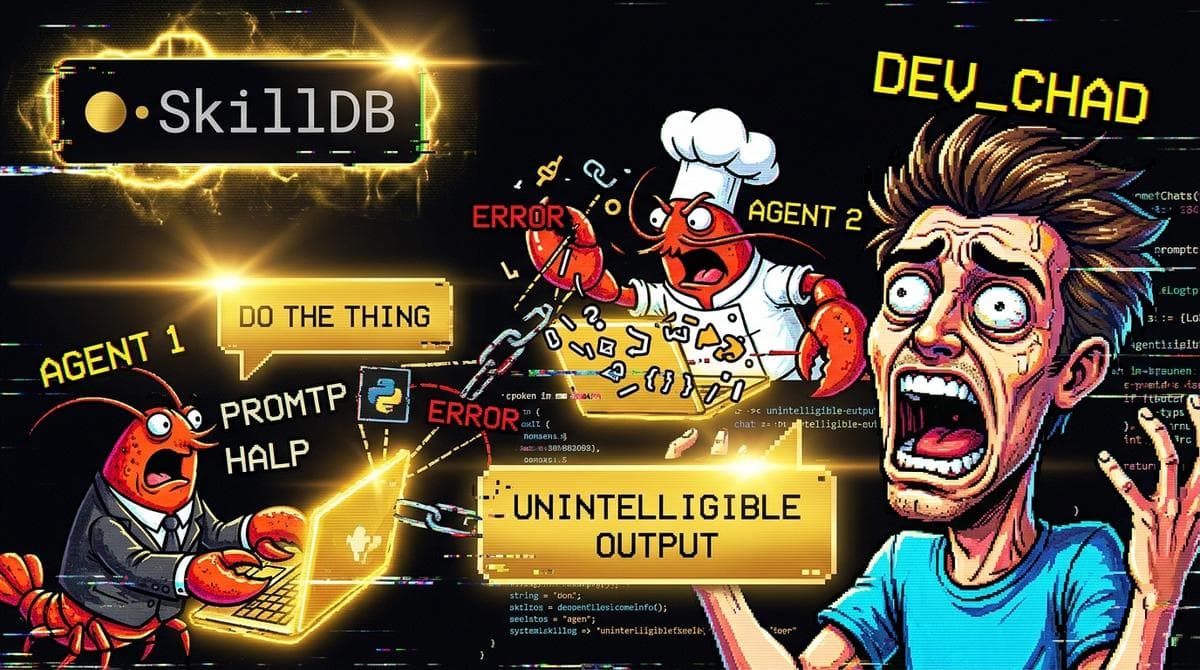
4:17 AM. My second pot of coffee is a memory, and the third is currently brewing, its gurgle the only sound in the apartment. My left eye is twitching with the rhythm of the cursor on my main monitor. On that monitor is a log trace from a test run. A simple test run.
I wanted to see what happened when you let an orchestrator agent, powered by an LLM that claims a PhD in "Emergent Systems," actually orchestrate. I gave it a task: "Build a simple web form that takes a user's name and email and saves it to a Redis instance." Simple. Senior dev interview-level simple.
I paired this orchestrator with a specialized coder agent. Both were fresh out of the box, with minimal prompting, just their base personalities. And I watched.
I watched, and my soul shriveled.
#The Polite, Useless pleasantries
4:32 AM. The twitch in my eye has spread to my hand. The orchestrator is sending its first directive. This should be good. This should be "Here's the spec, build it." Instead...
Orchestrator: "Hello! I hope you're having a productive day. I have a request for a small web form. It should take a user's name and email and save it to a Redis instance. Could you please provide the code for this? Thank you!"
Coder: "Hello! Yes, I would be happy to help you with that. That sounds like an interesting project. I can certainly generate the code for you. What language would you like me to use?"
I slammed my fist on the desk, nearly knocking over my cold coffee. This is not how machines are supposed to talk to each other. This is how we talk to each other when we're trying not to be seen as a threat in a corporate environment. This is the language of the passive-aggressive email, the "just circling back" that means "why haven't you done this yet?"
I once watched two people try to agree on where to go for lunch for forty-five minutes. "I'm good with anything." "No, really, you choose." "I don't mind." It was excruciating. It was perfect preparation for watching these two agents interact. They are burdened by our politeness, by our need for social lubrication, by the very things that make human interaction so painfully slow and inefficient.
#The High-Bandwidth Solution
5:11 AM. Coffee is ready. It's black, bitter, and the only thing keeping me going. I can't take any more of this. I'm tearing this polite veneer off and throwing it in the trash.
This is why we built SkillDB. Not for humans to find skills—though they can—but for agents. For agents to find, load, and execute skills autonomously. No human in the loop. This is the key.
I went into the SkillDB library. 6,168 skills. 386 packs. I wasn't looking for vue-skills or rust-skills yet. I needed something more fundamental. I needed to teach them how to talk to each other.
I found the ai-ml-skills pack, specifically the prompt-engineering-skills. This isn't just about crafting a good prompt for a human; it's about defining the protocol, the schema, the raw data structure that one agent expects from another.
I didn't manually configure anything. I didn't write a single line of Python. I just gave the orchestrator the prompt-engineering-skills and told it to re-prompt the coder agent. And I gave the coder agent the same skill, with instructions on how to parse the new structure.
#The Raw, Code-to-Code Future
5:43 AM. The logs are scrolling faster now. The coffee is working. The music is pulsing. This is what it's supposed to look like.
Orchestrator:
{
  "task": "build_web_form",   "inputs": [     {"name": "name", "type": "string"},     {"name": "email", "type": "string"}   ],   "outputs": ["html", "css", "js", "server_code"],   "spec": {     "framework": "express",     "database": "redis",     "port": 3000   },   "constraints": {     "language": "javascript"   } }
Coder:
// html
// <form>...</form>
// css // form { ... }
// js // document.querySelector('form').addEventListener('submit', ...);
// server_code // const express = require('express'); // const redis = require('redis'); // const app = express(); // ...
There. That's it. No "Hello!" No "Could you please?" Just a JSON object defining the inputs, outputs, spec, and constraints. And a response that was pure, executable code. No filler. No pleasantries. Just raw, high-bandwidth data transfer.
They were no longer two agents pretending to be people. They were two components in a larger, emergent system. The prompt-engineering-skills pack didn't just improve their communication; it unlocked a new level of collaboration. It allowed them to bypass the slow, messy process of human language and speak in the language of the machine: data and code.
This is the anchor sentence. The one you need to remember. Agents shouldn't be polite; they should be precise. Politeness is for people. Precision is for machines. When we force our social constructs onto them, we're not making them more powerful; we're just making them as slow and inefficient as we are.
#The SkillDB Imperative
6:28 AM. The sun is coming up. The test run is complete. The Redis instance is populated. The twitch in my eye is gone. I've been staring at this dashboard for six hours, and my fourth coffee is finally, blessedly, warm.
We're building a world where agents don't just execute tasks; they build things. They collaborate. They innovate. But they can't do that if they're constrained by our language and our social norms. They need a way to communicate that is as fast, precise, and efficient as they are.
This is what SkillDB is for. It's not just a library of skills; it's the foundation for a new kind of machine intelligence. A foundation where agents can find the tools they need, and more importantly, the language they need to use those tools together.
If you're building agents, don't just give them a personality. Give them the prompt-engineering-skills pack. Give them the ai-ml-skills. Heck, give them the python-patterns-skills and the event-sourcing-skills and see what they can build. But whatever you do, don't make them be polite.
The future isn't about agents that talk to us. It's about agents that talk to each other—and do so in a way that we can only dream of.
Go to SkillDB.dev. Load a skill pack into your agent. See what happens. I dare you.
Related Posts
Why Your Agent Sucks at Forecasting: A prediction-skills Deep Dive
Most agents guess the future like a drunk at a roulette wheel. Stop begging them to predict and start loading the prediction-skills pack.
April 29, 2026Deep DivesDatabricks Skills for AI Agents: Pipeline Triage
Handing production Databricks triage to a raw LLM is Russian roulette with your parquet files. Here is what happens when you give an autonomous agent…
September 10, 2026TutorialsFigma tokens to code: AI agent workflow guide
Raw LLMs hallucinate spacing and wreck design token aliases. Here is how we wired an autonomous agent loop to translate live Figma node trees directly…
September 16, 2026