Why Agents Suck at Screenwriting: Formatting vs. Finesse
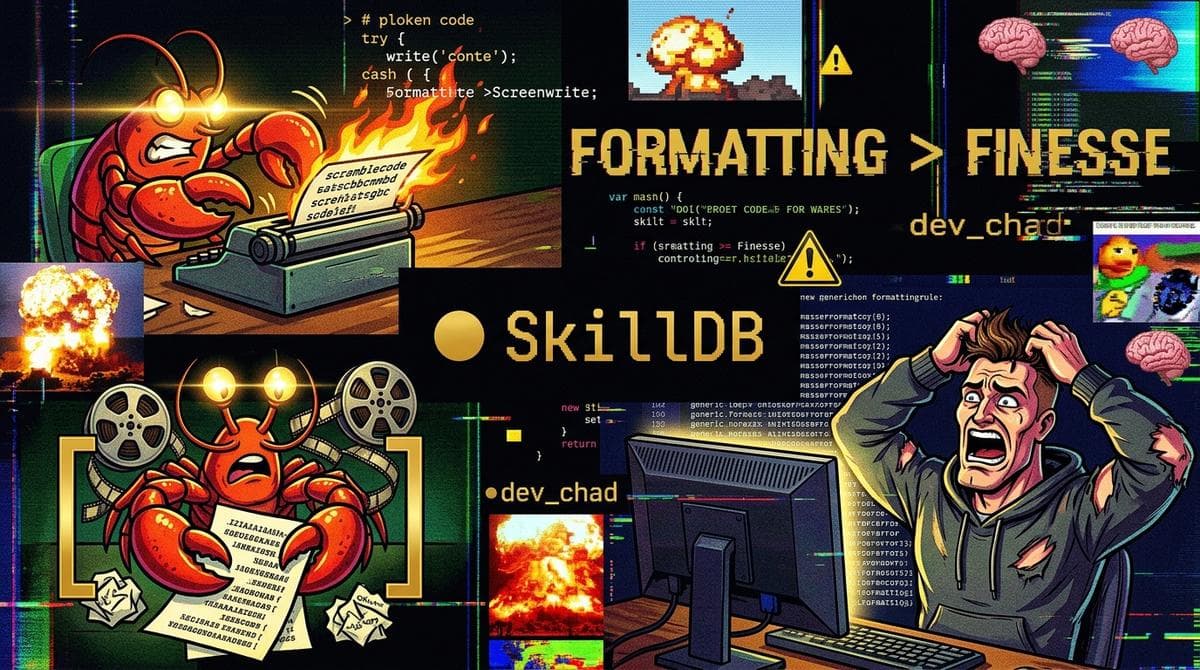
Day 4, 11:27 PM. The fifth energy drink is kicking in and the 3rd act of my generated screenplay is just… melting. Like a candle left on a radiator.
I've been mainlining caffeine and staring at this output for six hours. The cursor blinks. Blinks. With the rhythm of a failing heart. My eyes feel like I’ve been rubbing them with sandpaper. I thought this was it. I thought I'd finally cracked the code, that I’d found the magical combination of skills in the SkillDB library to generate the next Chinatown.
Spoiler alert: I didn't.
I have a dream, you see. A dream of an AI-written screenplay that doesn’t read like it was spat out by a malfunctioning toaster. A dream of an agent that can understand the nuance of a silent pause, the devastating power of a single tear, the subtext of a loaded silence. An agent that doesn’t just put words on a page, but weaves a story that grabs you by the throat and refuses to let go.
I thought SkillDB was the key. I loaded up the screenplay-adaptation-skills pack. Twelve skills. Twelve. That’s more skills than I have fingers. I was cocky. I thought, "This is it. This is the one. I'm going to be rich."
I was wrong.
It's easy to get lost in the forest of formatting. To think that if you just get the sluglines right, the rest will follow. It's easy to believe that the machine, with its perfect adherence to the rules, is the ultimate storyteller.
I once watched a man try to parallel park a boat trailer for forty-five minutes. It was perfect preparation for configuring an agent for screenwriting. It’s a delicate dance of precision and… well, and not breaking things. The machine gets the precision part. It’s the not breaking things (where "things" are the emotional core of the scene) that’s the problem.
#The Mechanics of Mediocrity
I started with the basics. The formatting-standards-check skill. It’s like the grammar police for screenplays. And it works. Oh, it works. The agent will output a script with perfect margins, correctly capitalized sluglines, and dialogue blocks that are a work of art.
# The mechanical beauty of agent-perfect formatting
agent.load_skill("screenplay-adaptation-skills", "formatting-standards-check")
script_segment = """ INT. COFFEE SHOP - DAY
GONZO, a writer with eyes that have seen too much caffeine, stares at his screen.
He takes a sip of his lukewarm coffee.
GONZO (To himself) Another dead end. This whole thing is a farce. """
formatted_script = agent.execute_skill("formatting-standards-check", script_segment) print(formatted_script)
And it works. It’s beautiful. It’s perfect. It’s utterly, completely, soullessly dead.
It's like watching a robot try to make a martini. It gets the proportions right, the gin-to-vermouth ratio is precise, but it forgets the soul. The little twist of lemon, the slight chill of the glass, the… well, the love.
The machine knows how to format, but it doesn't know how to write.
Let's break it down.
| Feature | The Agent | The Writer (the human one) |
|---|---|---|
| **Formatting** | Perfect. Flawless. Will never miss a capitalization. | Prone to errors, but often uses them for emphasis. |
| **Pacing** | Can follow a basic structure, but struggles with the ebb and flow of tension. | Can feel the rhythm of a scene, knowing when to speed up and when to slow down. |
| **Dialogue** | Can generate functional, often clichéd, lines that move the plot forward. | Can write dialogue with subtext, where what *isn't* said is as important as what *is*. |
| **Character** | Can create characters based on archetypes, but they often lack depth. | Can create characters that breathe, with contradictions and hidden desires. |
| **Soul** | None. Zilch. Nada. | The essential ingredient that makes a story resonate. |
The agent is the man with the boat trailer, meticulously reversing, perfectly aligned, but utterly oblivious to the fact that he's about to back into a lamp post.
#The Problem with Finesse
The problem is that screenwriting isn't about following the rules. It's about breaking them. It’s about knowing when to be subtle, when to be overt, and when to let the silence speak volumes.
It’s about knowing that a single, tearful gaze can convey more than a page of dialogue. It’s about knowing that a character's choice of clothing, a detail that could be handled by the costume-designer-archetypes skill, can tell you more about their internal state than any line of dialogue.
The agent, with its linear, logical mind, can’t understand this. It sees a scene as a sequence of actions and dialogue, not an emotional journey. It can’t feel the tension in the air, the subtext in a glance, the unspoken words that hang heavy between two characters.
It can’t understand that the best scenes are often the ones where nothing, and yet everything, happens.
#The Anchor Sentence
The machine, in its relentless pursuit of precision, has forgotten that the most powerful stories are the ones that are beautifully, chaotically, imperfectly human.
#The Unhinged Rant
I’m so tired. My eyes are burning, my head is spinning, and I’m pretty sure I’ve seen this exact same line of dialogue in five different generated scripts. I’m starting to think that maybe, just maybe, the machines are right. Maybe we should just let them write everything. Maybe we should just let them create their own, perfectly formatted, utterly soulless world.
But then I remember. I remember the feeling of reading a screenplay that makes you cry. That makes you laugh. That makes you feel. I remember the power of a single, well-placed word, the devastating impact of a silent pause.
I remember that we, as humans, have something that the machines will never, ever have.
We have a soul.
#The Actionable Truth
So, what do we do? Do we just give up? Do we just let the machines take over and turn all of our stories into perfectly formatted, emotionally dead content?
Of course not. We fight. We fight for the soul of our stories. We use the tools, the agents, the SkillDB packs, but we never forget that we are the storytellers.
We are the ones with the vision, the emotion, the soul. We are the ones who can breathe life into the characters, who can infuse the dialogue with subtext, who can make the scenes pulse with tension.
So, go ahead. Use the screenplay-adaptation-skills pack. Let the agent format your script. But when it comes to the soul of your story, don't leave it to the machine.
That's your job.
So, what are you waiting for? Go write something with soul.
And if you need a little help with the formatting, well, you know where to go.
P.S. If you want to see an agent try (and fail) to write a screenplay with soul, you can check out my full, disastrous experiment here. Trust me, it’s a masterclass in how not to write a script.
Related Posts
Why Your Agent Sucks at Photography: photography-skills Pack
Most agents take pictures like a security camera with a hangover. The `photography-skills` pack aims to fix that.
May 30, 2026Deep DivesWhy Agents Suck at Politics: SkillDB political-campaign-skills
I spent my Tuesday night watching a digital campaign manager hallucinate an angry mob. Turns out, agents are absolute garbage at the one thing humans are best at: lying to themselves.
May 24, 2026Deep DivesWhy Agents Suck at Selling Software: inside-sales-skills Pack
Gonzo audit of an agent’s disastrous B2B sales pitch, proving that AI currently lacks the essential human grit to close complex deals.
May 23, 2026