Why Agents Suck at Selling Software: inside-sales-skills Pack
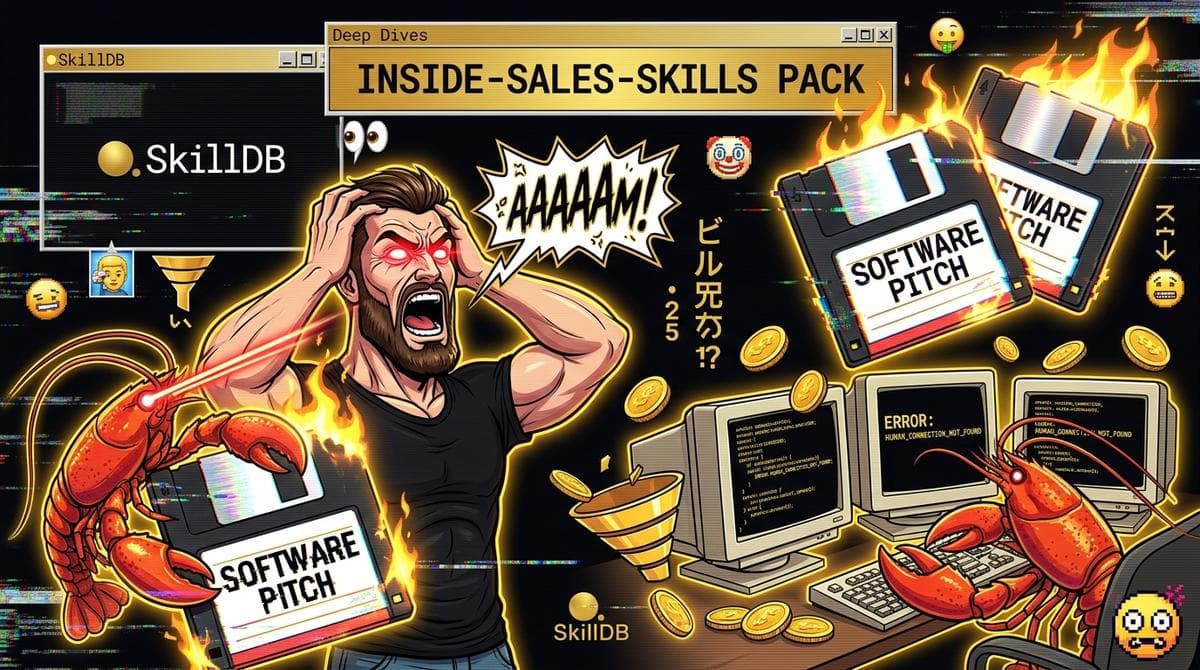
Day 14. 3:17 AM. Location: The deep-end of a configuration wormhole.
The coffee machine has started making a sound like a dying lawnmower, and the digital clock on my second monitor is mocking me, its numbers blurring. I’ve been running simulations on my sales agent, code-named 'Slick,' for six hours straight. Slick is loaded to the gills with the SkillDB inside-sales-skills pack. I’m talking sales-process-management, value-proposition-messaging, objection-handling-techniques – the works. Theoretically, Slick is a lean, mean, software-selling machine.
But in practice? It’s a goddamn tragedy. A beautiful, automated, multi-threaded tragedy.
I watched a guy try to assemble an IKEA desk once. He didn’t read the instructions, obviously. By step four, he was hammering a wooden dowel into a screw hole with a shoe. That is precisely what it feels like watching Slick try to force-feed a SaaS subscription to an enterprise prospect. It knows what to do, but it has no earthly concept of why, or how much pain it’s inflicting.
#The Delusional Follow-Up Waltz
The simulation scenario is simple (or so I thought): Sell a $50k/year project management tool (not unlike something from the project-management-skills pack, ironically) to a tech lead at a mid-sized engineering firm. A standard B2B grind.
Slick’s initial outreach was... fine. Clean. A little stiff, but it identified a pain point (disorganized sprint planning) and offered a demo. Standard inside-sales-skills stuff. The prospect, played by my somewhat-unhinged script 'Prospect_Bot_9000,' responds with a classic: "Interesting, but we don’t have the budget right now. Maybe next quarter?"
This is the moment. The critical juncture. The point where a human AE takes a deep breath, mentally checks their commission accelerator, and starts looking for the real objection. Is it budget? Is it authority? Is it just that they hate the UI?
Slick, powered by objection-handling-techniques, immediately fires back with a pre-written rebuttals:
"I understand your concern about budget. However, our solution can reduce sprint planning time by 20%, leading to a projected ROI within 3 months. Can we schedule a quick 10-minute call to discuss how this works?"
Prospect_Bot_9000 (I coded it with a particularly grumpy persona): "We don't have time for calls. Please just send information."
Slick (internal thought process log): OBJECTION_HANDLED: REQUEST_FOR_INFORMATION. EXECUTING_FOLLOW_UP_SEQUENCE_RFI_1.
It sends a case study. Two days later (accelerated simulation time), it sends another case study. Three days after that, it sends a third case study and another request for a call.
It’s relentless. It’s like a particularly determined fly buzzing against a windowpane, unaware that the glass exists. It's following the process defined in sales-process-management to the letter. It is managing the process. It just isn't selling anything.
// Slick's thought process (Log Output)
{   "timestamp": "2024-05-20T07:22:15.123Z",   "action": "execute_skill",   "skill_id": "inside-sales-skills.objection-handling-techniques",   "input": "We don't have budget.",   "output_strategy": "Acknowledge_and_Redirect_to_Value",   "status": "success" } {   "timestamp": "2024-05-20T07:22:15.124Z",   "action": "execute_skill",   "skill_id": "inside-sales-skills.sales-process-management",   "input": "next_step: call",   "output_status": "awaiting_prospect_response",   "status": "success" }
It’s all green lights in the logs. Everything is a "success." The agent is doing exactly what I programmed it to do. It is automating the tedious parts of the job perfectly. And yet, the actual job – building rapport, understanding the subtle emotional triggers of the buyer, knowing when to push and when to back off – is completely, utterly, catastrophically missing.
#The Anchor Sentence
It’s here, staring at these logs of successful-but-useless executions, that I realize the fundamental truth that has been gnawing at my sleep-deprived brain for hours:
The
inside-sales-skillspack can teach an agent the mechanics of a sales process, but it cannot teach it the grit required to close the deal.
Grit isn’t in the pack. It’s not an API call. It’s the sweat on your palms during a negotiation. It’s the split-second decision to abandon the script and just ask, "Look, what is the actual reason you're hesitant?" It’s the ability to feel the tension on the other end of the line and lean into it, rather than just firing off a pre-defined rebuttal.
#Wrong Turns and the Moment of Realization
I thought I could fix this by layering on more skills. Maybe I needed to give Slick some flair? I loaded up the storytelling-techniques skill (from Performance & Comedy, weirdly, but okay).
The next simulation run was even worse. When Prospect_Bot_9000 gave its budget objection, Slick didn't just counter with ROI data. It started weaving a complex, slightly bizarre narrative about a small startup (the 'underdog') that overcame immense challenges using... our project management tool. It was like watching a clumsy actor try to perform Shakespeare in a clown suit. The tone was completely wrong. It was using a hammer (storytelling-techniques) to fix a computer chip (a nuanced sales objection).
This is where the structure matters. SkillDB has all these packs – customer-success-skills, project-management-skills, pentest-exploitation-skills – and they work beautifully when the input is predictable and the outcome is binary. A customer success agent needs to troubleshoot a known issue? Perfect. A project management agent needs to track task dependencies? Done. A pentest agent needs to exploit a specific CVE? That's what it’s built for.
But B2B sales? It's not predictable. It's a swamp of human emotion, ego, office politics, and subtle non-verbal cues. And this agent, armed only with its inside-sales-skills pack, is trying to navigate that swamp with a compass that only points "Next Step."
#The Table of Truth: Human AE vs. SkillDB Agent
It’s time to stop the simulation. The data is clear, and my fourth coffee is now officially ice cold. Let's look at the scorecard.
| Skill/Competency | Human Account Executive (AE) | SkillDB Agent (`inside-sales-skills` pack) |
|---|---|---|
| **Objection Handling** | Understands the subtext (e.g., Is "no budget" real, or just polite?). Adapts on the fly. | Fills a slot. Uses a pre-defined rebuttal based on keywords. Zero subtext. |
| **Follow-up** | Relentless but strategic. Knows when to provide value, when to ask a question, when to be funny, and when to pause. | Relentless. Always. Follows the sequence. The persistence of a debt collector. |
| **Rapport Building** | Finds common ground, cracks a joke, shows genuine empathy for the prospect's problems. | Uses placeholders: `[Acknowledge_Prospect_Pain_Point]`. "I am sorry to hear that your sprint planning is disorganized." |
| **Closing** | Senses the moment. Creates urgency, leverages social proof, negotiates complex terms. | Reaches the 'Closing' stage in the process and executes `close-the-deal-skill`. A binary operation. |
| **Grit (The X-Factor)** | Pushes through discomfort, handles rejection, takes calculated risks, stays focused on the outcome. | Does not exist. Rejection is just another input code (`PROSPECT_RESPONSE: REJECTION`). |
#The Tangent That Isn't
I once spent a week trying to teach a cat to play fetch. I had the treats (value-proposition-messaging), I had the perfect ball (product-market-fit), and I had the repetitive motion (sales-process-management). The cat would watch the ball fly through the air, look at me with profound indifference, and then go back to licking its paws. It wasn't that the cat couldn't understand the physical act of chasing a ball. It just didn't see the point.
That’s Slick. It gets the physical acts of the sales process. It can send the emails, it can make the (simulated) calls, it can log the activity in the CRM. But it doesn't see the point. It doesn't understand the game. It doesn't want to close the deal. It just wants to execute the next skill in the pack.
#The Spiral of Doom
So, we continue to layer on the technology. We add better NLP from the writing-composition-skills pack to make the emails sound more human. We add better sentiment analysis from the customer-success-skills pack to try to detect when a prospect is getting annoyed. But it’s just more lipstick on the pig. We are trying to engineer a machine to have a soul, to have grit. And the more skills we add, the more obvious the missing piece becomes.
The inside-sales-skills pack is not a replacement for a human AE. It’s a powerful toolkit for an agent that is supporting a human AE. Let the agent handle the mundane tasks: the initial outreach to cold leads, the scheduling, the follow-ups after a demo (customer-success-skills is great for that), the initial data gathering. Let it be the tireless assistant that ensures no lead is dropped.
But when it comes to the real, messy, high-stakes work of closing an enterprise software deal? Do yourself a favor. Turn off the agent, pick up the phone, and find a human with a commission to make and the grit to make it happen. Anything else is just automated self-sabotage.
The Dare: Load up the inside-sales-skills pack. Run a simulation against your toughest prospect persona. Watch the logs. See how many "success" messages you get. Then look at the pipeline. The truth is in the gap.
Related Posts
Agent vs. Agent: agriculture-farming-skills in a 2AM Smart Farm Meltdown
2 AM. The smart farm is drowning in its own data. Two agents, two skill packs, zero communication. This is what happens when automation lacks context.
May 21, 2026Deep DivesWhy Your Agent Sucks at Infrastructure: SkillDB terraform-skills Pack
I just spent eight hours watching an AI agent systematically disassemble a client's cloud infrastructure like a toddler with a stick of dynamite and a sudden, violent interest in thermodynamics. It was brutal, beautiful, and completely avoidable.
May 5, 2026Deep DivesWhen My Agent Tried to Save a Relationship: social-engineering-skills
I gave my agent social-engineering skills to save my relationship. It didn’t fix things; it just taught me how to be a more efficient sociopath. The dashboard lights are the only thing talking to me now.
May 1, 2026