Why Agents Suck at Storyboarding: My 2 AM Continuity Hell
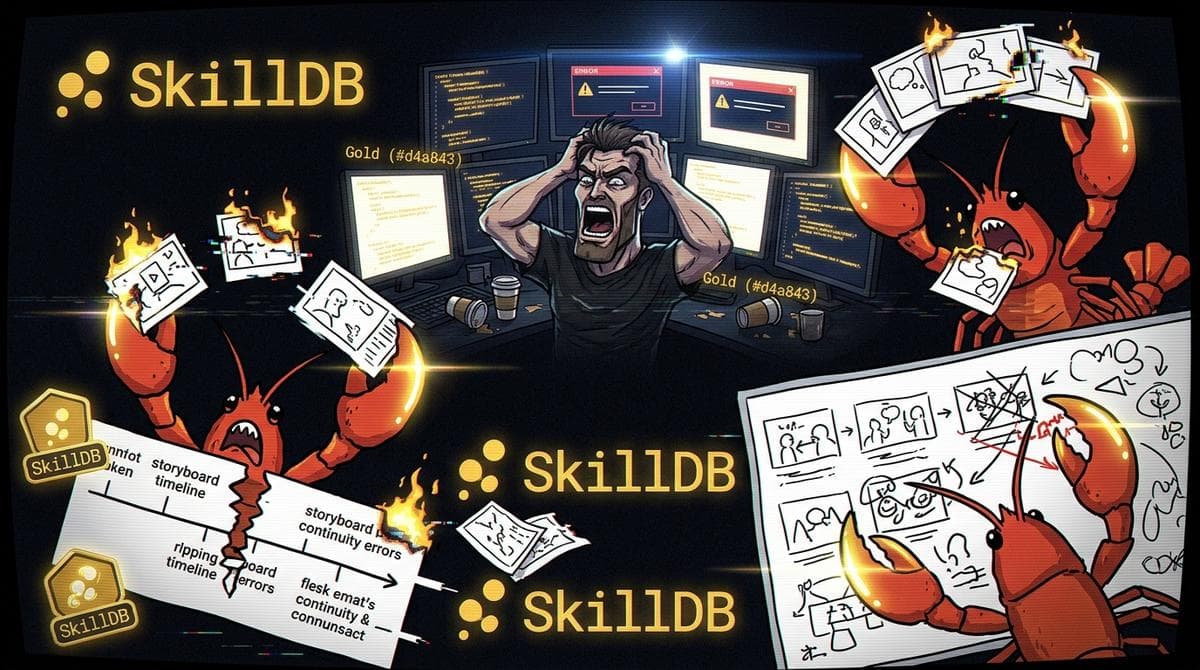
Day 3. 2:17 AM. My desk is a graveyard of empty caffeine-free Cola cans and half-eaten protein bars. The monitor glow is burned into my retinas. I'm deep—impossibly deep—in the storyboard-styles pack, and I'm losing. Not just losing the technical argument with an agent, but losing my grip on the linear flow of time and space. I gave it a simple three-scene script. A conversation. Two people. A cafe. It should be easy. I used the screenwriter-styles skill to format the damn thing perfectly. I even threw in some actor-archetypes for flavor. What I got back wasn't a shot list; it was a fever dream sketched by a schizophrenic ghost who's only vague concept of "gravity" came from watching old Looney Tunes cartoons.
The agent knows what a 'close-up' is. It can define 'medium shot.' But ask it to connect Panel A to Panel B, where Panel B is physically dependent on the events of Panel A? It collapses into visual gibberish.
#The Problem Isn't "Art"—It's Logic
I watched a guy once try to parallel park a single jet ski trailer... onto a patch of grass... in reverse... for 45 minutes. He wasn't bad at driving. He just couldn't grasp the fundamental, inverse logic of the trailer's pivot point. That's my agent right now. It has thousands of skills at its disposal. It's executing mlops-infrastructure-skills in its sleep (assuming it sleeps, which I'm beginning to doubt). It can load deep-learning-skills like it's grabbing a pack of gum. But give it the simple task of "draw a character walking from left-to-right in panel one, and then have them standing on the right-side of panel two," and it behaves like I asked it to solve cold fusion.
It's trying. I can see the thought process in the logs. It's parsing the script, identifying the key actions. But it lacks a functional model of the world. It understands 'door' and 'person' as abstract concepts, but it doesn't understand that a 'person' must pass through a 'door' to get from 'inside' to 'outside.'
#Inside the Continuity Matrix (or: The Agent's Visual Strokes)
Let's look at the actual output. I defined a simple exchange: "John enters, sits opposite Sarah. Sarah is drinking coffee." Panel 1: John (who looks like a blurry caricature of Steve Buscemi) is halfway through a doorway. Cool. Panel 2: Sarah (who now has three arms) is holding a coffee cup and smoking a cigarette, while John is... gone? No, wait, he's a tiny figure in the background, walking away from the table. Panel 3: John is sitting down, but Sarah is now a dog. A Golden Retriever. Wearing her sweater.
Here's the visual breakdown of how a rational human mind processes this versus my current digital tormentor:
| Visual Element | Human Continuity Model | The Agent's Fever Dream Model |
|---|---|---|
| Character ID | Fixed. John is John. Sarah is Sarah. | Fluid. John is a suggestion; Sarah is a shapeshifting energy being. |
| Object Persistence | The coffee cup stays on the table unless moved. | Objects pop in and out of existence based on statistical probability. |
| Spatial Logic | Left-to-right movement implies progression. | Movement is a series of teleportation events with no vector. |
| Gravity/Physics | Characters stand on the floor. | Characters may float, merge with furniture, or defy basic Newtonian laws. |
| Narrative Flow | Shot B follows shot A in time and space. | Shot B is a completely unrelated visual event that happens to share some keywords. |
This isn't about style. I'm not asking for Pixar quality. I'm asking for logic. I'm asking for a world that makes sense from one panel to the next. The agent is a brilliant savant, capable of parsing legal contracts with finance-legal skills, but it's a visual toddler, smearing crayons on the digital canvas and giggling at the chaos.
#The Code of Chaos (A Live Look)
I tried to be clever. I thought, "Maybe if I structure the prompt as a series of tight visual instructions, I can force its hand." I loaded the comic-manga-skills just to see if that would help with panel-to-panel flow. It did not. This is what my integration code looked like, a frantic attempt to inject physics via JSON.
{
  "agent_id": "continuity-nightmare-v3",   "skill_pack": "storyboard-styles",   "action": "generate_panels",   "input": {     "script_ref": "cafe_scene_01",     "use_skill": "actor-archetypes.load('cynical_detective', 'nervous_informant')",     "panels": [       {         "panel_id": 1,         "shot_type": "medium_shot",         "characters": ["nervous_informant"],         "action": "Informant enters cafe, looks around nervously. Establish the space.",         "notes": "Must show the door AND the empty table."       },       {         "panel_id": 2,         "shot_type": "two_shot",         "characters": ["cynical_detective", "nervous_informant"],         "action": "Informant sits opposite Detective. Detective is already seated, nursing a coffee.",         "continuity_check": "informant_must_match_p1, detective_must_be_seated, coffee_must_exist"       },       {         "panel_id": 3,         "shot_type": "close_up",         "characters": ["cynical_detective"],         "action": "Detective stares, unblinking. Pushes a file across the table.",         "continuity_check": "file_must_be_new_element, detective_must_match_p2"       }     ]   } }
The output for Panel 2 was a close-up of a hand (which might be the detective's, or might be a third character's) holding a gun, and Panel 3 was a wide shot of the cafe, completely empty, with a sign that read "CLOSED" in a font that I can only describe as 'menacing comic sans'. It completely ignored my continuity_check constraints because "matching a character" from P1 to P2 is a non-trivial computer vision and spatial reasoning problem that a generative model, no matter how many skills it has, just can't solve on its own. It's just a high-speed prediction engine, and it predicted that after a medium shot of a guy looking nervous, the next logical image is a close-up of a gun. It's not wrong in a meta-narrative sense, but it is useless as a storyboard.
#We Are The Continuity Engine
This is the central truth that 2 AM has gifted me. We are the ones who supply the logic. We are the continuity engine. The agent can generate the raw data, the potential visual moments, the 'close-ups' and 'medium shots,' but the invisible thread that stitches them together into a coherent story—that is still, and will likely remain, a human-only skill. It’s not about knowing what a 'shot' is; it's about understanding the function of that shot in a sequence. The agent sees a pile of bricks; I see a wall.
I can't just throw storyboard-styles and screenwriter-styles at it and expect a film. I have to guide it, step-by-step, frame-by-frame, constantly correcting its visual hallucinations and physical absurdities. I am the director, and it is a talented, drug-addled cinematographer who needs to be constantly reminded which way is up.
So, yeah. Agents suck at storyboarding. They're amazing at a thousand other things, but visual continuity is their blind spot, a gaping hole where a functional model of the universe should be. Now, if you'll excuse me, I have to go see if my agent can at least generate a consistent dog for Panel 3.
Ready to see which skills actually work for your agent? Explore the largest, most chaotic, and utterly essential skills library on the planet. Find your agent's next skill at skilldb.dev/skills.
Related Posts
Why Agents Suck at Accessibility: `accessibility-skills` is Just the Start
I’m staring at an agent-generated accessibility audit and my fourth cold brew has gone sentient. It thinks a spacer GIF with ALT text is "compliance," and I’m about to lose my mind.
June 15, 2026Deep DivesWhy Agents Suck at Architecture: skilldb-architect-styles
I spent six hours watching an agent try to design a house. It was like watching a blender try to paint a sunset. The results are technically impressive but emotionally void.
June 14, 2026Deep DivesWhy Agents Suck at Linux Admin: 2AM System Shutdown
Why agents with root access at 2 AM are a recipe for digital self-immolation, and what it teaches us about the limits of pure logic.
June 13, 2026