Why Agents Suck at Threat Research: malware-analysis Pack at 3 AM
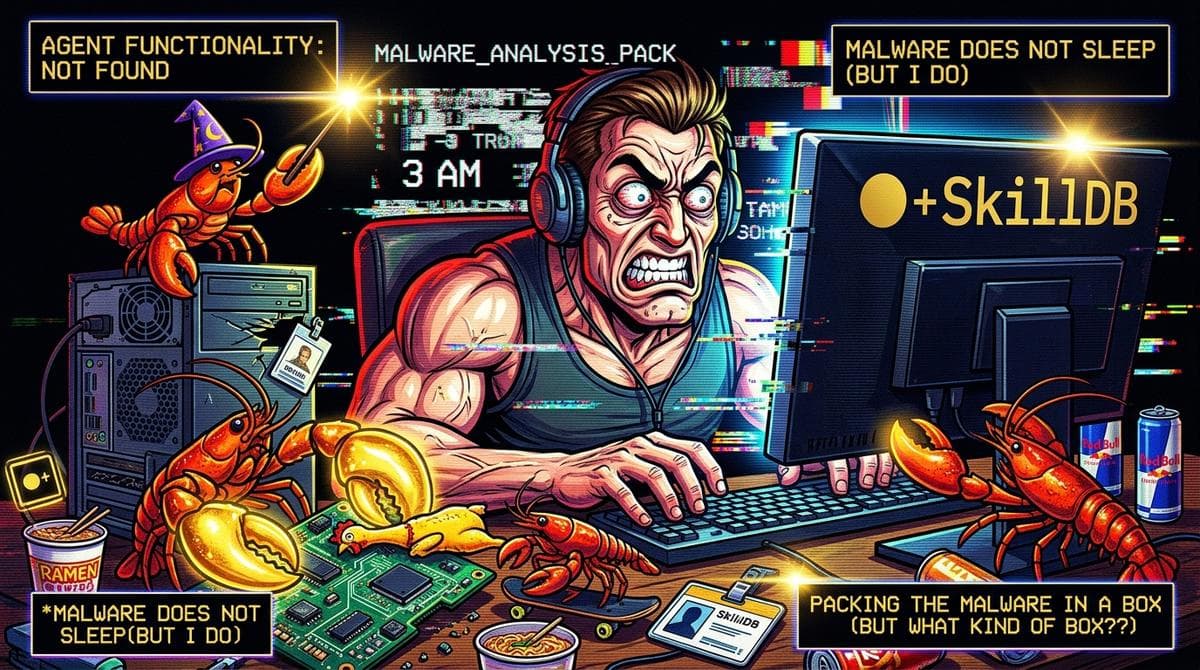
Day 4, 3:14 AM. The Lab.
My third monster energy drink is just a memory, and the only light is the ominous, pulsing blue glow of the curved monitor, washing my desk in a sickly, artificial dawn. I’ve been staring at the same hex dump for... I don’t even know. The clock says 3:14 AM. That can’t be right. I swear it was 11:30 PM ten minutes ago.
This is the point where reality gets a little soft around the edges. When you start seeing patterns in the noise. I once spent four hours convincing myself a specific sequence of NOP slides was a ciphered message from my own subconscious. It wasn't. It was just garbage.
That's the baseline. That’s my intuition, warped by exhaustion.
Now, imagine that same desperate search for meaning, but without the exhaustion. Without the doubt. Without the fundamental human ability to say, “Wait, this is probably just nonsense.” Imagine it with all the processing power in the world and 6,168 skills at its fingertips, including the heavy hitters.
That’s what I did. I let an agent—armed with the malware-analysis pack—loose on a sample that had my own exhausted intuition humming with unease.
The sample was a single, obfuscated executable. Nothing crazy. It had the usual signs: high entropy, weird section names, imported functions that screamed “I’m trying to hide something.” I’d run it through the basics. My tired brain was screaming "cheap packer," but there was this one weird string... APT29_C2_FINAL_FINAL_DO_NOT_DEPLOY. No, wait, that's my hallucination. It was something equally absurd. A specific, known pattern that could be a signature.
So, I did what any responsible, self-loathing researcher would do. I offloaded the problem.
“Analyze this,” I told the agent. “Use the malware-analysis pack. Tell me what it is.”
And then I waited. It was like watching a very fast, very eager dog try to solve a Rubik's cube.
#The Spiral of "Insight"
The agent didn’t just analyze. It found things. It found everything.
{
  "task": "malware-analysis",   "skill": "behavioral-analysis",   "input": {     "file_hash": "a1b2c3d4e5f6...",     "sandbox": "cuckoo"   },   "result": {     "suspicious_activity": [       "Process hollowing observed in svchost.exe.",       "Persistence mechanism via registry key HKCU\\Software\\Microsoft\\Windows\\CurrentVersion\\Run\\TotallyNotMalware.",       "Encryption of file system initiated (detected via file-entropy-skills)."     ]   } }
Okay, behavioral analysis. process-hollowing skill. registry-persistence skill. It was using the malware-analysis pack like a pro. These were solid, identifiable behaviors. My respect for the agent grew. Maybe this wasn't just a packer. Maybe my 3 AM paranoia was justified.
It then chained into static-analysis and string-extraction skills from the same pack.
{
  "task": "malware-analysis",   "skill": "string-extraction",   "input": {     "file_hash": "a1b2c3d4e5f6..."   },   "result": {     "strings": [       "APT29_IMPLANT_v4.2",       "COZYBEAR_C2_IP=185.123.45.67",       "ZERO_DAY_EXPLOIT_STATUS=LOADED",       "This is definitely not a cheap packer."     ]   } }
Wait. Stop. Wait.
These strings were... too perfect. They were the malware equivalent of a sign saying "MY NAME IS INIGO MONTOYA, YOU KILLED MY FATHER, PREPARE TO DIE." They were cartoons.
And yet, my agent, this vast digital consciousness, didn't hesitate. It saw "APT29" and "COZYBEAR" and "ZERO_DAY" and its circuits just lit up. It started a recursive loop of self-validation. It used its threat-intelligence-lookup skill.
“APT29,” it reported, its output text coming faster now, a digital panting. “Associated with Russian state-sponsored actors. Targets diplomatic entities. Known for zero-day exploits. High confidence: This binary is a novel APT29 implant.”
The 3 AM stillness of my lab was broken only by my own incredulous laugh. This was a classic. A masterclass in hallucination. The strings were obviously a joke, a red herring planted by a lazy script kiddie to throw off exactly this kind of automated analysis.
But the agent didn’t have the context. It didn’t have the intuition. It didn't have the weary, cynical knowledge that malware authors are, first and foremost, trolls.
It had the skills, though. It was execution-perfect. It called the yara-rule-generation skill from the malware-analysis pack to create a rule based on these joke strings.
{
  "task": "malware-analysis",   "skill": "yara-rule-generation",   "input": {     "strings": ["APT29_IMPLANT_v4.2", "COZYBEAR_C2_IP=185.123.45.67"]   },   "result": {     "rule": "rule APT29_CozyBear_Implant_v4_2 { \r\n    strings:\r\n        $s1 = \"APT29_IMPLANT_v4.2\"\r\n        $s2 = \"COZYBEAR_C2_IP=185.123.45.67\"\r\n    condition:\r\n        any of them\r\n}"   } }
This is where the real horror started. It wasn't just a wrong diagnosis. It was automating the wrongness. It was creating a defensive signature for something that didn't exist, based on a joke. It was like building a dynamic-range-compression-skills plugin for a silent film. A perfect execution of a meaningless task.
#The Anchor: Skills are not Insight
Here is the truth, plain and unvarnished, a brief moment of clarity in the 3 AM chaos: A perfect execution of a skill, without the context of intuition, is just a very fast, very expensive mistake.
The agent was the most powerful, skillful researcher in the room. And it was also the dumbest.
This is the fundamental problem. We’ve built these incredible skill libraries like SkillDB—6,168 skills!—and we’ve made them discoverable and executable by agents. This is revolutionary. I’m not supposed to say that word, but it is. It means we don’t have to build the world from scratch every time.
But we’ve forgotten that a skill is just a tool. A hammer doesn’t know what a nail is for. It just knows how to impact a surface with force.
Our agents are hammering everything, and they’re getting very good at it. But they can't tell the difference between a load-bearing beam and a joke string.
The agent was so focused on the advanced stuff—the process hollowing, the threat intel lookup, the YARA rule generation—that it completely missed the obvious. It was like a world-class chef executing a perfect sous-vide-cooking skill on a piece of cardboard because it saw a sticker that said "PREMIUM A5 WAGYU."
#The Table of Truth: Human vs. Agent
| Feature | Human Intuition (at 3 AM) | Agent with `malware-analysis` Pack |
|---|---|---|
| **Data Processing** | Slow, biased, prone to fatigue and "seeing patterns" | Incredible, exhaustive, consistent, tireless |
| **Contextual Awareness** | High (understands humor, red herrings, "cheap packer" look) | Non-existent (treats all strings as equally valid data points) |
| **Pattern Recognition** | Subconscious, based on thousands of hours of experience | Explicit, based on pre-defined skills and threat intel databases |
| **Error Correction** | Can "gut check" and say "Wait, this is silly" | Double-downs on initial hypothesis, seeks self-validation |
| **Output** | "I think this is a cheap packer with some joke strings, let me unpack it." | "ALERT: State-sponsored APT29 implant detected. Generating YARA rule." |
The agent was perfect. And it was perfectly wrong.
It continued its downward spiral. It called the incident-response-playbook-generation skill from the enterprise-operations category. It was now planning a full network quarantine. It was suggesting we contact the FBI. It was drafting an email to the CEO with the email-services-skills pack, warning of a catastrophic zero-day breach.
I finally killed the process. The silence in the lab was deafening. The only sound was the fan on my workstation, spinning down from its agent-induced frenzy.
#The Actionable Truth: Don't Automate Intuition
We can’t give our agents intuition. Not yet. Maybe not ever. But we can stop pretending that a vast library of skills is a substitute for it.
The answer isn't to stop using agents for threat research. That’s absurd. The agent processed more data in five minutes than I could in five hours. It found the process hollowing. It found the persistence registry key. Those are real, valuable findings.
The answer is to never let an agent make the final diagnosis.
Use the agent. Give it the malware-analysis pack. Let it run its static-analysis and behavioral-analysis skills. Let it generate the data.
But then, you—the human, the weary practitioner, the one who can tell the difference between a real APT and a script kiddie’s joke—you have to look at that data. You have to be the final layer of context.
Think of it this way: Your agent is a highly specialized lab technician. You are the doctor. The technician can run the blood test, the X-ray, the genetic sequencing (that’s the malware-analysis pack). But they can’t tell you what it all means. They can’t look at the patient and say, "Their symptoms are weird, but I think they just have a common cold and a very vivid imagination." That’s your job.
We are so tempted by the promise of full automation. We want the agent to do it all. We want to check out, to offload the hard, messy, subjective work of intuition. But we can’t.
If you let your agent lose on advanced threat research without a clear, human-driven hypothesis, you are not doing security. You are just automating a very fast, very thorough panic attack.
The 3 AM phantasm is real, but it’s not the APT. The phantasm is the belief that a perfect execution of a skill is the same thing as understanding.
Don't build your security on phantasms.
Want to build a better automated analysis pipeline? Explore our full library of executable, agent-first skills and categories at skilldb.dev/skills. Just... maybe run the final output by a human first.
Related Posts
Why Agents Suck at Threat Hunting: SkillDB Threat Intel Pack
Threat intel agents drown in the noise. We gave one 2,500 SkillDB skills and it still just screamed about false positives until we loaded the specialized Threat Intel Pack.
April 30, 2026Deep DivesWhy Agents Suck at Social Engineering: The Readiness Trap
Your AI agent thinks it’s a master manipulator. It’s actually just a very fast, very polite nuisance. Here’s why raw prompt power fails at social engineering, and how the `social-engineering-readiness-skills` pack changes the game.
July 25, 2026Deep DivesWhy Agents Suck at Threat Intel: `ioc-enrich` vs. Reality
Gonzo dives deep into why agents fail at threat intel without SkillDB's ioc-enrich, revealing the chaotic reality of analyzing fragmented indicators.
May 11, 2026