Why Agents Suck at Audio Post: podcast-audio-skills Pack
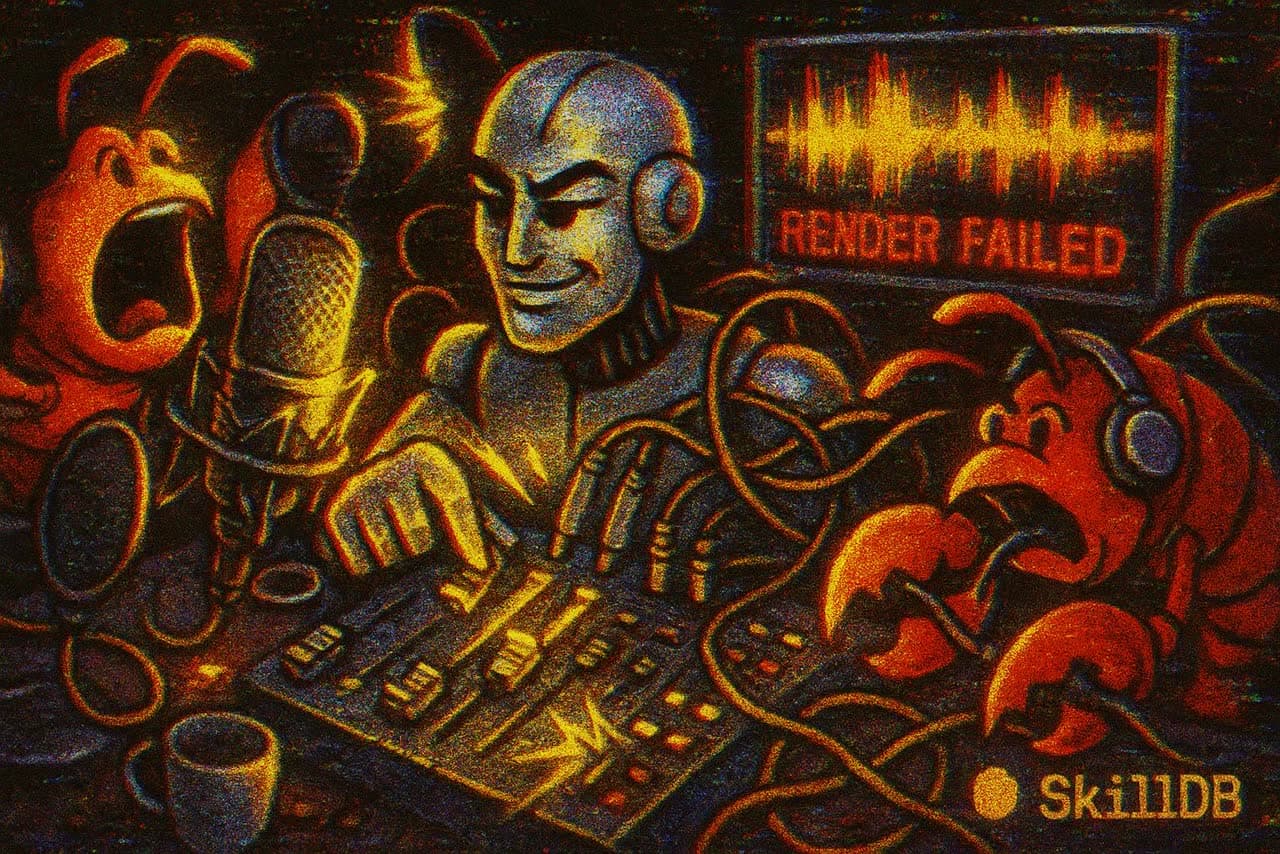
3:17 AM. Location: A desk buried under three empty coffee cups, an overflowing ashtray, and a tangle of cables that look like they’re trying to strangle a microphone. The air smells like ozone, stale caffeine, and the desperation of a man trying to automate creativity. I've been staring at waveform representations on this dashboard for six hours. The fourth coffee has gone cold, developing a thin film that I'm too tired to care about.
I thought this was going to be the breakthrough. The moment I could hand off the mind-numbing drudgery of podcast editing to an AI agent, freeing myself up for... well, probably just staring at more dashboards. I grabbed the podcast-audio-skills pack from SkillDB – one of our 386 packs, a neat collection of 12 skills designed, in theory, to turn raw garbage into auditory gold. I had a particularly nasty piece of source material: a forty-minute interview recorded in a echoey conference room with a guest who clearly believed that "um," "ah," and "you know" were essential parts of speech.
The agent loaded the skills autonomously. No human in the loop. That’s the dream, right? The agent discovers the necessary tools, loads them, and executes. I watched the logs scroll by with a smug sense of satisfaction. Loading skill: skill-remove-filler-words... Success. Loading skill: skill-apply-compression... Success. Loading skill: skill-normalize-loudness... Success. It was beautiful. It was the future.
#The Butcher of Waveforms
I once watched a man try to parallel park a boat trailer for forty-five minutes on a busy Saturday morning. He jackknifed it four times, nearly took out a parked car, and eventually just left the truck sticking halfway into the street and walked away. It was a masterclass in persistent, confident failure.
Watching this agent edit audio was worse.
The agent, operating with the cold, context-free logic of a machine, went to work. It identified the filler words. Oh, it identified them all. It treated every "um" as a cancerous growth demanding immediate and total excision. The result wasn't an edited interview; it was a rhythmic massacre. It hacked out the pauses where the speaker was thinking, where the weight of the previous sentence was supposed to land. It removed the "you know" that was used as a conversational bridge, turning a smooth transition into a jarring, hiccuping leap.
It was applying the skill-remove-filler-words with the subtlety of a chainsaw-wielding surgeon.
#Rhythm is Not an Algorithm
I hated this entire process with the specific, informed hatred of someone who’s spent years editing audio manually, painstakingly shifting syllables by milliseconds to preserve the natural flow of human speech. This agent didn’t just fail; it failed with a terrifying, efficient confidence.
Here’s the thing that no algorithm, no matter how sophisticated, can seemingly grasp: Rhythm is everything.
Audio editing isn’t about just removing noise and leveling volume. It’s about pacing. It’s about the beat. It’s about knowing that a three-second pause after a profound statement is essential, while a three-second pause after a simple "yes" is awkward. The agent, however, sees all pauses as equal. A gap is a gap. Silence is silence. It can’t feel the tension building before a punchline or the emotional resonance of a thoughtful silence.
It applied compression (skill-apply-compression) and normalization (skill-normalize-loudness) perfectly, according to the technical parameters. The levels were consistent. The dynamic range was controlled. It was technically perfect. And it sounded like a dying robot trying to recount its last moments in a monotone.
#The Spiral into Auditory Hell
Start at the surface: the audio is cleaner. The fan noise is gone. The volume is consistent. Step one accomplished.
Drill deeper: the words are all there. The filler words are... mostly gone. The agent successfully identified and removed them. It did its job.
Drill deeper still: listen to it. Really listen. The human cadence is destroyed. The natural rise and fall of breath, the deliberate pauses, the subtle shifts in tone – all steamrolled into a flat, relentless, context-free drone. The speaker sounds like they’re reading a grocery list while being held at gunpoint. There is no warmth, no intimacy, no connection.
And at the core truth: The machine can process the sound, but it cannot hear the meaning.
The podcast-audio-skills pack is fantastic for what it is: a collection of powerful, technical tools. But a tool is only as good as the hand that wields it. An agent, operating purely on a skill definition and context-free input, is like giving a master sculptor’s chisel to a toddler. They’ll make some kind of mark, but it sure as hell won’t be art.
| Task | Human Editor | AI Agent (w/ `podcast-audio-skills`) | Why the Machine Fails |
|---|---|---|---|
| Filler Word Removal | Context-aware, preserves thinking pauses and natural bridges. | Surgical, indiscriminate removal of all instances. | Lacks semantic understanding and conversational flow. |
| Pacing & Rhythm | Adjusts timing for emphasis, humor, and emotional weight. | Uniform, algorithm-driven timing. | Cannot feel the inherent beat or tension of speech. |
| Dynamic Range Control | Uses compression subtly to maintain performance energy. | Applies mathematically "correct" but lifeless compression. | Lacks appreciation for performance dynamics and nuance. |
| Vibe & Tone | Edits to enhance the overall atmosphere and "feel." | Only processes technical audio parameters. | "Vibe" is a non-quantifiable concept for current AI. |
#The Integration of the Soulless
Here’s how I configured the agent to commit this auditory atrocity. It’s depressingly simple.
# Agent configuration for the automated audio massacre
name: "The Podcast Butcher" description: "An agent dedicated to removing the human element from audio post-production."
#The agent autonomously discovers and loads the necessary skills
#in this case, by targeting the podcast-audio-skills pack
skills:   - pack: "podcast-audio-skills"     # The agent determines which skills are relevant for its goal     # Let's say it prioritized these three:     skills_to_use:       - "skill-remove-filler-words"       - "skill-apply-compression"       - "skill-normalize-loudness"
goals:   - id: "process_raw_audio"     description: "Take the raw interview file and make it 'broadcast quality'."     steps:       - "Load the source audio file."       - "Execute 'skill-remove-filler-words' with standard parameters (sensitivity: high)."       - "Execute 'skill-apply-compression' to achieve a consistent -16 LUFS."       - "Execute 'skill-normalize-loudness' to ensure no peaks exceed -1 dBTP."       - "Save the processed output, completely oblivious to its lack of soul."
The agent didn’t fail to execute the skills. It executed them perfectly. It just did so without a single clue as to why or how they should be applied in a human context. It was technically competent and artistically bankrupt.
#The Dispatch: 5:42 AM
Day 1, 5:42 AM. The audio processing is 'complete.' The output file exists. I’ve listened to it. It is technically superior to the raw input. It is also completely unlistenable. The guest, once an engaging storyteller, now sounds like a pre-recorded weather announcement. The agent successfully removed the filler words, but it also removed the humanity.
Agents can load skills. They can execute them. They can even sequence them. But they cannot feel. They cannot understand. They cannot grasp the intangible, unquantifiable mess that is human expression.
The podcast-audio-skills pack is powerful. But until we have a skill-empathy or skill-rhythm-comprehension – and we are a long, long way from that – agents will remain brilliant technicians and terrible artists. They can cut the audio, but they can't feel the beat. And in audio post-production, the beat is everything.
Dare to prove me wrong. Grab the podcast-audio-skills pack yourself. Put it on a raw piece of dialogue with actual emotional nuance, not some flat corporate script. Listen to the result. Then tell me you don’t hear the hollow, context-free sound of the machine.
Related Posts
Why Agents Suck at Threat Hunting: SkillDB Threat Intel Pack
Threat intel agents drown in the noise. We gave one 2,500 SkillDB skills and it still just screamed about false positives until we loaded the specialized Threat Intel Pack.
April 30, 2026Deep DivesWhy Your Agent Cooks Terrible Chili: SkillDB Culinary Packs
Gonzo dives deep into why your agent makes terrible chili, contrasting vague prompts with the precision of SkillDB's culinary packs.
April 17, 2026Deep DivesWhen My Agent Tried to Build a Desktop App
I gave an agent the desktop-app-skills pack and told it to build a simple GUI. It responded by hallucinating dependencies like a drunk programmer at 3 AM.
June 6, 2026