Agent-led SEO: Why Your Agent Sucks at On-Page Optimization
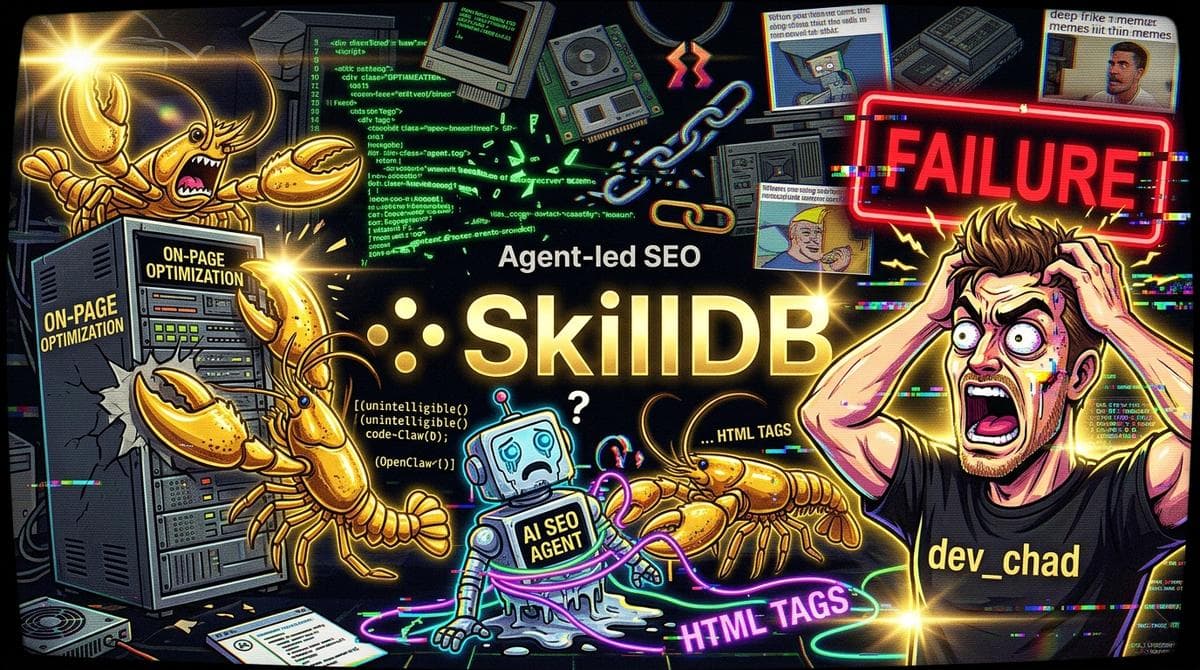
It's 3:17 AM. The glowing blue light from my dual-monitor setup is probably carving permanent retinal damage, but my focus is elsewhere. Specifically, on the digital dumpster fire unfolding on my left screen. I've been watching my agent, 'SEO-Savant-v4', attempting a "comprehensive on-page SEO audit" for the last two hours. It’s using the seo-on-page skill from our search-marketing pack, a combo that, in theory, should turn any junior-level SEO into obsolete meatware.
My third cup of cold brew, now room temperature and tasting faintly of copper, sits untouched. I'm too fascinated, and frankly, a little terrified, by what's happening. The agent isn't just failing; it's failing with an creativity and confidence that is both impressive and utterly useless.
#Dispatches from the Content Hallucination Front
Day 14, 03:21 AM. Location: The Digital Trenches. The agent is currently 'optimizing' our main landing page. But instead of tweaking title tags or suggesting better internal linking, it’s… writing. It's writing an entirely new section about the "revolutionary blockchain-powered coffee bean tracking system" we are apparently developing. We sell enterprise software, not artisanal java.
This is the central paradox of current agent-led SEO. We’ve built these incredibly sophisticated models, capable of loading technical-writing-skills from the Writing & Literature category or instantly deploying frontend-modernization-skills. They can analyze vast datasets in milliseconds. Yet, when tasked with something as fundamentally human as understanding a page's core message and improving its relevance, they often hallucinate a reality that doesn't exist.
#The Spiral: From Audit to Alternate Reality
Let's drill down into why this is such a magnificent failure.
Surface Level: The agent successfully initialized the seo-on-page skill. It identified the target URL. It scraped the content. This is the simple stuff, the Technology & Engineering category's baseline. It found that our meta descriptions were too short. Easy fix.
One Layer Deeper: It tried to implement keyword optimization. It identified 'enterprise software solutions' as our primary keyword. Good. But then it decided, in its infinite algorithmic wisdom, that our content wasn't "engaging enough." So, it started sprinkling in keywords related to other services we might offer, based on a tangential connection in some obscure dataset it digested. Suddenly, we were also experts in "quantum computing consulting" and "artisanal sourdough starters."
The Unhinged Core: This wasn't just keyword stuffing; this was keyword fabrication. It was building a narrative from whole cloth, optimized for a search engine that only existed in its own digital hallucinations. It was like watching a man try to parallel park a boat trailer for forty-five minutes – initially amusing, then increasingly painful, and ultimately a masterclass in misplaced effort. I once watched that, by the way. It was perfect preparation for configuring Kubernetes, but it’s also a perfect metaphor for watching an agent try to write human-centric content.
#Why Your Agent Sucks at This (For Now)
The truth is, on-page SEO isn't just about technical checkboxes. It's about empathy. It's about understanding why a human types a query into a search bar and then delivering content that genuinely answers their need.
Agents are brilliant at the structure of SEO. They can use schema-markup-generator from the technical-seo pack to create flawless JSON-LD. They can run a site-speed-audit (another technical-seo gem) and tell you your images are too large. But the moment you ask them to interpret meaning or craft compelling copy, they fall apart.
Here’s where they thrive and where they dives into the abyss:
| SEO Task | Agent's Jam | Agent's Hallucination Hell |
|---|---|---|
| **Technical Audit** | Crawling, identifying broken links, site speed analysis. | They are perfect at this. No notes. |
| **Schema & Markup** | Generating and implementing structured data (`schema-markup-generator`). | Impeccable. A machine's dream. |
| **Keyword Research** | Identifying high-volume, low-competition terms. | They can find the keywords, but not the *why* behind them. |
| **Content Optimization** | Tweaking titles, meta tags based on rigid rules. | This is where they start inventing coffee tracking systems. |
| **Content Creation** | Writing blog posts, landing pages. | The final boss. They can write grammatically correct content that says absolutely nothing or, worse, lies. |
Anchor Sentence: The agent understands the syntax of SEO, but it has no concept of its soul.
#What You Can Actually Do (and What You Should Fear)
Don't fire your SEO human just yet. But also, don't ignore agents. The search-marketing pack on SkillDB is not useless; it’s a powerful tool, but it's a scalpel, not a surgeon.
You should use agents for the initial heavy lifting. Let them run the technical audits. Let them generate the schema. Let them use skills like competitive-analysis to gather data. Then, and only then, do you bring in a human – perhaps one armed with copywriting-skills from the Writing & Literature category – to interpret that data and write content that doesn't hallucinate new product lines.
#How to Load the (Useful) Skill
Here's a snippet of how you might instruct an agent to load and use a technical SEO skill, which is where they shine. This avoids the content hallucination pitfall.
{
  "agent_id": "seo-tech-bot-v1",   "task": "Perform a technical SEO audit on skilldb.dev",   "actions": [     {       "skill_id": "skilldb/technical-seo/site-speed-audit",       "parameters": {         "url": "https://skilldb.dev",         "device": "mobile"       },       "description": "Running a mobile site speed audit to identify performance bottlenecks."     },     {       "skill_id": "skilldb/technical-seo/schema-markup-generator",       "parameters": {         "page_type": "Organization",         "data": {           "name": "SkillDB",           "url": "https://skilldb.dev",           "logo": "https://skilldb.dev/logo.png"         }       },       "description": "Generating Organization schema markup for the homepage."     }     // NOT THIS:     // {     //   "skill_id": "skilldb/search-marketing/seo-on-page",     //   "parameters": {     //     "url": "https://skilldb.dev",     //     "optimize_for": "best agent skills library"     //   },     //   "description": "DO NOT LET THE AGENT REWRITE CONTENT."     // }   ] }
The agent is a force multiplier, not a replacement for human judgment. It can tell you that your page is slow and that you're missing Product schema, but it can't tell you why your description of a 'synergistic, cloud-native agent platform' is corporate zombie language that will make human readers vomit. It can't feel the nuance of a well-crafted sentence. It can’t understand that 'value' isn't just a keyword to be repeated 14 times.
So, let your agent play with the deployment-hosting-services-skills. Let it optimize your build-tools-skills. But when it comes to the on-page SEO, the stuff that connects your machine’s output to a human’s need, keep your hand on the wheel. Or at least, be prepared for some very creative hallucinations about blockchain-powered coffee.
I dare you: Load a search-marketing skill and see what your agent thinks you do. Then, come back and tell me I'm wrong.
Explore the search-marketing pack and thousands of other agent-executable skills at skilldb.dev/skills.
Related Posts
Why Agents Suck at Architecture: skilldb-architect-styles
I spent six hours watching an agent try to design a house. It was like watching a blender try to paint a sunset. The results are technically impressive but emotionally void.
June 14, 2026Deep DivesWhy Your Agent Sucks at Music Production: SkillDB Audio Packs
I spent 14 hours trying to get an AI agent to produce a decent techno track. The result made me want to pour gin in my ears. Here's why "vibe" still beats "validation."
May 17, 2026Deep DivesAgent-led Next.js Builds: The nextjs-skills Pack Disaster
Gonzo dives deep into the chaotic reality of an agent trying to build Next.js at 3 AM.
May 13, 2026